

Hey there! As a supplier of ≥98.0% Dimethyl Fluoromalonate CAS NO.344-14-9 [/fluoromalonate/98-0-dimethyl-fluoromalonate-cas-no-344-14-9.html], I've been getting a lot of questions about the reaction conditions when it comes to reacting this chemical with metal salts. So, I thought I'd share some insights based on my experience and industry knowledge.
First off, let's talk a bit about what Dimethyl Fluoromalonate is. It's a pretty useful chemical, and having it at a purity of ≥98.0% means you're getting a high - quality product. This compound has those fluorine atoms, which can bring some unique reactivity to the table. Fluorine is highly electronegative, so it can influence the way the molecule interacts with other substances, especially metal salts.
Now, when it comes to the reaction conditions, one of the most important factors is the choice of solvent. Different solvents can have a big impact on how the reaction proceeds. For the reaction between ≥98.0% Dimethyl Fluoromalonate and metal salts, polar aprotic solvents like acetonitrile or dimethylformamide (DMF) are often good choices. These solvents can dissolve both the Dimethyl Fluoromalonate and the metal salts well, and they don't have acidic protons that could interfere with the reaction.
Let's say you're using a metal salt like copper(II) chloride. In acetonitrile, the Dimethyl Fluoromalonate and the copper salt can form a homogeneous solution. The reaction might start with the lone pairs on the oxygen atoms in the Dimethyl Fluoromalonate coordinating to the copper ion. This coordination can lead to the formation of an intermediate complex.
The temperature also plays a crucial role. Generally, for these types of reactions, a moderate temperature is often ideal. Too low, and the reaction might be too slow. Too high, and you could start getting side reactions or decomposition of the reactants. For many reactions between Dimethyl Fluoromalonate and metal salts, a temperature in the range of 40 - 60°C can work well. At this temperature, the molecules have enough energy to react, but not so much that they start breaking apart.
Another thing to consider is the stoichiometry of the reactants. You need to make sure you have the right ratio of Dimethyl Fluoromalonate to the metal salt. If you have too much of one reactant, it can lead to an incomplete reaction or the formation of unwanted by - products. For example, if you're reacting with a divalent metal salt, you might want to use a 2:1 ratio of Dimethyl Fluoromalonate to the metal salt in some cases.
The reaction time is also important. It can vary depending on the specific metal salt and the reaction conditions. Some reactions might be complete in a few hours, while others could take overnight. You can monitor the progress of the reaction using techniques like thin - layer chromatography (TLC) or nuclear magnetic resonance (NMR). These methods can help you see when the reactants are being consumed and the products are being formed.
It's also worth mentioning that the presence of a base can sometimes be beneficial. A weak base like potassium carbonate can help deprotonate any acidic hydrogens in the reaction mixture and promote the reaction. However, you need to be careful with the amount of base you use, as too much can also cause side reactions.
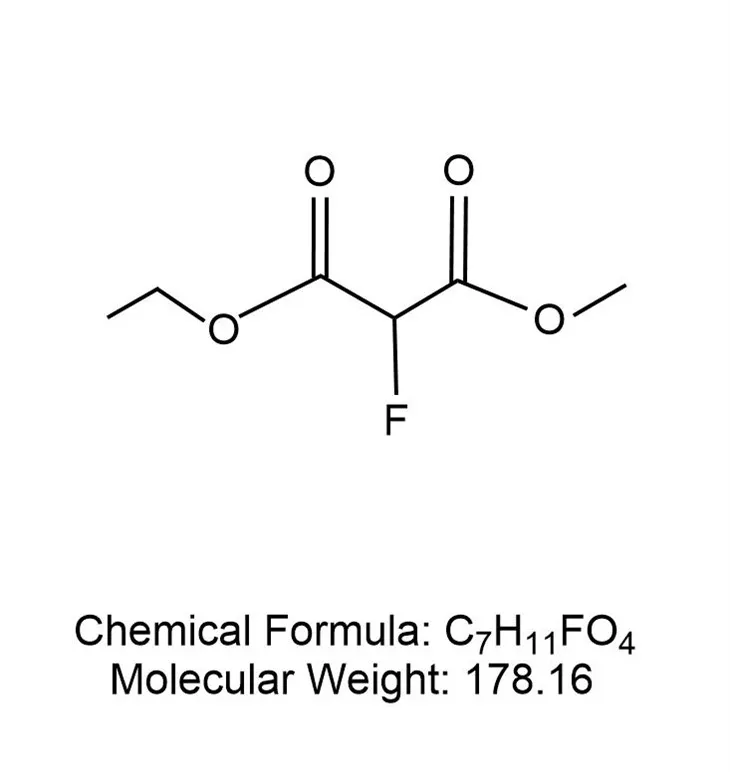
Now, let's compare Dimethyl Fluoromalonate with Diethyl Fluormalonate [/fluoromalonate/diethyl-fluormalonate.html] (Diethyl Fluormalonate CAS NO.685-88-1 [/fluoromalonate/diethyl-fluormalonate-cas-no-685-88-1.html]). While they are similar in structure, the difference in the alkyl groups (methyl in Dimethyl Fluoromalonate and ethyl in Diethyl Fluormalonate) can lead to some differences in reactivity. The ethyl groups in Diethyl Fluormalonate are bulkier than the methyl groups in Dimethyl Fluoromalonate. This can affect how the molecule approaches the metal salt and how the reaction proceeds. For example, the reaction with Diethyl Fluormalonate might be a bit slower due to the steric hindrance caused by the ethyl groups.
In summary, when reacting ≥98.0% Dimethyl Fluoromalonate with metal salts, you need to pay attention to the solvent, temperature, stoichiometry, reaction time, and the possible use of a base. Each of these factors can influence the outcome of the reaction.
If you're in the business of using Dimethyl Fluoromalonate in your chemical processes and need a reliable supplier, look no further. We're here to provide you with high - quality ≥98.0% Dimethyl Fluoromalonate. Whether you're doing research in a lab or running a large - scale production, we can meet your needs. Reach out to us to start a discussion about your requirements and let's work together to make your projects a success.
References

- "Advanced Organic Chemistry" by Jerry March
- Journal articles on organofluorine chemistry and metal - organic reactions.