


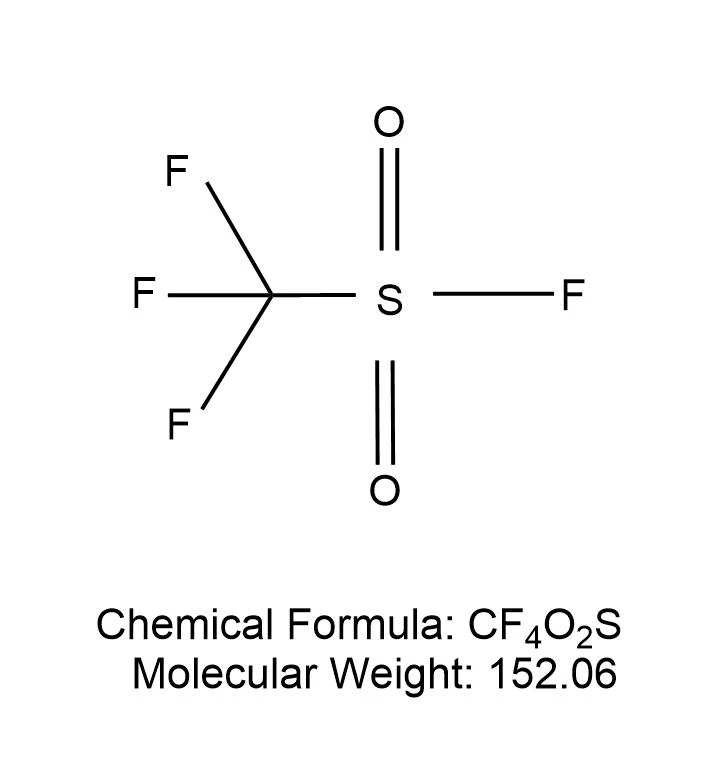
≥98.0% Trifluoromethanesulfonyl Fluoride CAS No.: 335-05-7
CF4O₂S
CAS No.: 335-05-7
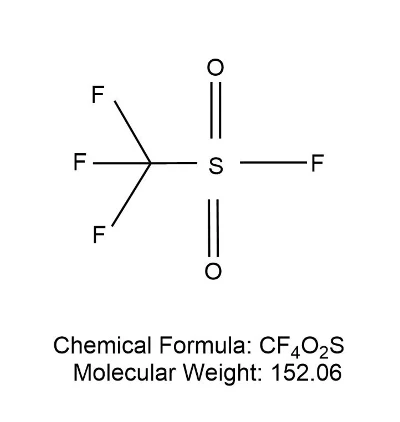
Application
The electronic industry is where it is primarily used. One example of a salt compound in the bis(trifluoromethylsulfonyl)imide salt family is lithium bis(trifluoromethylsulfonyl)imide (LiN(CF;SOz)2). It has good thermal stability and doesn't begin to break down until heated to 360°C. It is easily ionized, has the biggest anionic radius of any electrolyte lithium salt that is currently known, and a highly scattered anionic charge. It dissolves readily in organic solvents and forms an acidic Lewis solution. Its strong conductivity, high ion mobility, and considerable degree of dissociation in the solution are all present. As of right now, it's the most stable organic lithium salt electrolyte. With its strong electrochemical stability and ability to function as a lithium-ion battery, lithium bis(trifluoromethanesulfonyl)imide does not corrode aluminum liquid collectors at higher temperatures.At higher voltages, lithium bis(trifluoromethanesulfonyl)imide does not corrode aluminum liquid collectors and can be utilized as a lithium-ion battery due to its great electrochemical stability. Furthermore, it serves as the fundamental component needed to make a number of significant room temperature ionic liquids.
The compounds bis(trifluoromethanesulfonyl)imide and its homologous series, bis(trifluoromethanesulfonyl)imide salt (MN(CF:SO2)2), are used in Lewis acid catalyst for isomerization, catalytic reforming, olefin hydration, alcohol dehydration, toluene disproportionation, and acylation reactions, as well as in organic catalytic cracking and hydrocracking. This kind of acid catalyst offers several advantages over earlier conventional acid catalysts, including high activity, low dosage, regeneration, and non-pollution.
As a shielding gas
Arcs and sparks are frequently likely to develop when working with high voltage between electrical appliances, which can quickly result in danger. Dielectric gas can be used to completely remove the risk. SF6, a more costly dielectric gas, is more efficient. Later, less expensive substitutes like CClF2 emerged; however, the issue with these gases is that they can carbonize when exposed to high voltages, releasing free carbon in the process. This can be prevented by adding a small quantity of trifluoromethanesulfonyl fluoride to the gases.
Physical Properties
|
MF |
CF4O₂S |
|
Boiling point |
-25°C |
|
Density |
1.729±0.06 g/cm3(Predicted) |
|
Molecular mass |
152.06 |
|
Assay |
≥98.0% |
|
Package |
20kgs or according customer requirement |
|
If need more information like COA/MSDS etc,pls contact: sales01@huayangco.com |
|
Physical and chemical properties
[Density]: 1.729g/cm³
[Molecular formula]: CF4O₂S
[Molecular weight]: 152.06800
[Exact Mass]: 151.95600
[PSA]: 42.52000
[LogP]: 1.88630
[Refractive Index]: 1.359
Security Information
[Hazard Code (Europe)]: T: Toxic;
[Risk Statement (Europe)]: R20
[Safety Statement (Europe)]: 26-36/37/39
[Dangerous Goods Transport Code]: UN 3308
[HS Code]: 2904909090


Packing, Storage, Handling and Transportation
Nonafluorobutanesulfonyl fluoride should be kept in dark place, sealed in dry and stored in freezer under -20℃

FAQ
Q: What is the universal lead-time for order delivery?
Q: What payment terms do you accept?
Q: When can I get the feedback after we sent the enquiry?
Q: We will reply you within 12 hours in working day.
Q: What's your MOQ?
For an air transport order or sea delivery order ,the MOQ is usually 25 kgs.
Hot Tags: ≥98.0% trifluoromethanesulfonyl fluoride cas no.: 335-05-7, China ≥98.0% trifluoromethanesulfonyl fluoride cas no.: 335-05-7 manufacturers, suppliers, factory, 99 0 Methyl Nonafluorobutyl Ether CAS NO 163702 07 6, 99 0 Nonafluorobutanesulfonyl Fluoride CAS NO 375 72 4, Nonafluoro 1 Butanesulfinate Sodium Salt 1 1 CAS NO 102061 82 5, 99 0 Nonafluorobutanesulfonyl Fluoride, 3 4 5 6 tetrafluorophthalonitrile, 98 0 Dimethyl Fluoromalonate