



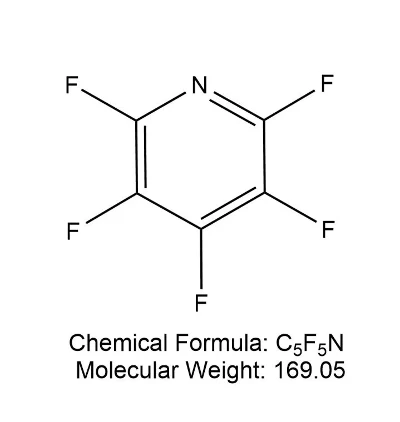
2,3,4,5,6-Pentafluoropyridine ≥99.0%
C5F5N CAS NO.700-16-3
Application

Method 1: The chlorine-fluorine exchange reaction is used to create pentafluoropyridine (PFPy) using 3,5-dichloro-2,4,6-fluoropyridine (DCTFPy) as the raw material. 50 g of chlorobenzene, 38.3 g of potassium fluoride (0.66 mol), 11 mmol of the matching catalyst, and 135 g of molten sulfolane (1.12 mol) were added one after the other. Distillation was used to azeotropically dry the mixture at lower pressure. 44.4 g of 3,5-dichloro-2,4,6-fluoropyridine (0.22 mol) was added to the heated reaction mixture after it had been cooled to 40°C and placed in an autoclave. Gas chromatography was used to measure the amount of pentafluoropyridine (PFPy) in the mixture after it had been heated to 215°C for 22 hours and then allowed to cool to room temperature. An 85% yield of pentafluoropyridine, the chemical mentioned in the title, was produced.
Method 2: Hexaalkylguanidine halide catalyst-based halogen exchange reaction device. A 220 ml stainless steel reactor with a stirrer, thermocouple, pressure gauge, and sample port was used to conduct the halogen exchange reaction. heated by an electric jacket. chemicals. Potassium fluoride should be calcined for two hours at 200°C before use. Prior to usage, nitrobenzene (98%) was distilled. routines. The reactor was filled with the quantities of ingredients listed in Table 2 for each run. Hexaethylguanidine bromide served as the catalyst for every reaction. After that, the reactor assembly is put in the heating mantle, the stirrer is connected to the motor, and the reactor head is fixed to the reactor body.The noise started. The speed of the stirrer is set at 200 ± 20 rpm. To attain reaction temperature, the reactor's contents were heated for around two hours. The target temperature of +2.5°C is maintained. The reactor's contents were routinely sampled and examined throughout the process. Via the sample port, remove the sample. Following the completion of the reaction, the reactor is disassembled and its contents are allowed to cool to room temperature. After that, the contents of the reactor were transferred into a 500 ml glass reactor, and to guarantee total product removal, the stainless steel reactor was cleaned with water. To dissolve KF and KCl, add water. The volatile organic components underwent azeotropic distillation.The distillation residue consists of polymer by-products dissolved in the organic and aqueous layers; these layers are separated. The organic layer was returned to the flask and distilled to dryness to obtain the title compound pentafluoropyridine with a yield of 5.6%.
Physical Properties
|
Melting point |
-42 |
|
Boiling point |
83-85℃ |
|
Density |
1.54 g/mL at 25 °C (lit.) |
|
Molecular mass |
169.05 |
|
Assay |
≥99.0% |
|
Flash point |
75℉ |
|
Vapor pressure (mmHg) |
42.8±0.2 mmHg at 25°C |
|
LogP |
0.91 |
|
Refractive index |
n20/D 1.386(lit.) |
|
Package |
200kgs or according customer requirement |
|
If need more information like COA/MSDS etc,pls contact: sales01@huayangco.com |
|


Packing, Storage, Handling and Transportation
2,3,4,5,6-Pentafluoropyridine should be stored under inert atmosphere at 2-8 ℃.

FAQ
Q: What is the universal lead-time for order delivery?
Q: What payment terms do you accept?
Q: When can I get the feedback after we sent the enquiry?
Q: We will reply you within 12 hours in working day.
Q: What's your MOQ?
For an air transport order or sea delivery order ,the MOQ is usually 25 kgs.
Hot Tags: 2,3,4,5,6-pentafluoropyridine ≥99.0%, China 2,3,4,5,6-pentafluoropyridine ≥99.0% manufacturers, suppliers, factory, , , Perfluorotributylamine CAS NO 311 89 7, 1 3 5 Trifluorobenzene Benzene