


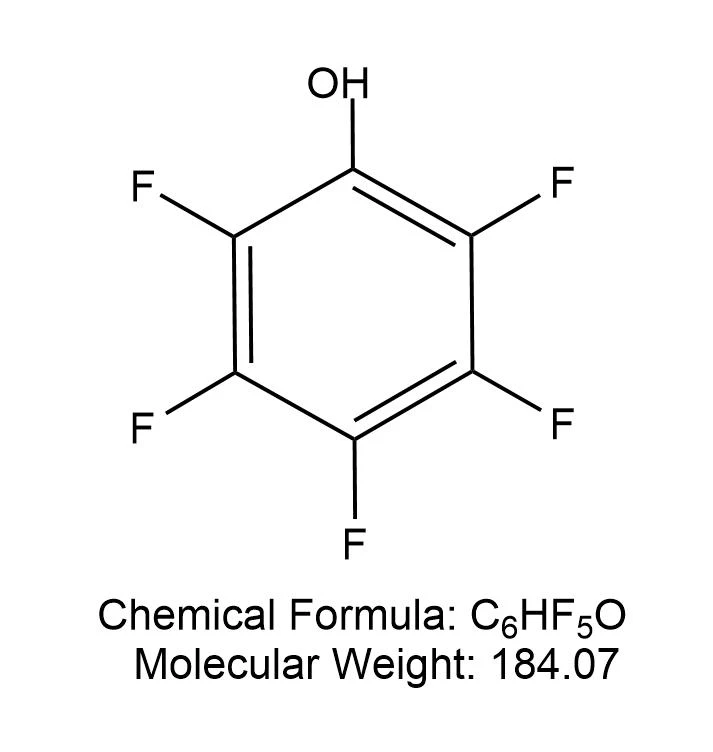
2,3,4,5,6-Pentafluorophenol CAS NO.771-61-9
C6HF5O
CAS NO.771-61-9
Application
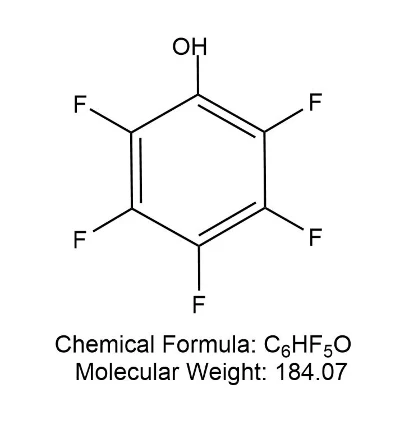
Pentafluorophenol, also known as 2,3,4,5,6-pentafluorophenol or PFP, is a colorless to pale yellow crystalline solid that belongs to the family of fluorinated benzene derivatives. This compound has a molecular formula of C6HF5O and a molecular weight of 186.06 g/mol. PFP is highly soluble in polar solvents such as water, methanol, and acetone, but only slightly soluble in nonpolar solvents such as hexane and toluene. PFP is a highly reactive compound that forms strong hydrogen bond networks and can participate in various types of chemical reactions.
PFP has wide applications in both academia and industry due to its unique properties and reactivity. Some of the main uses of PFP are described below.
1. Coupling agent in peptide and protein chemistry
One of the most common uses of PFP is as a coupling agent for peptide and protein synthesis, which involves linking amino acids or peptides together to form longer chains. PFP can activate carboxylic acids (COOH) to form acyl fluorides (COF) that can react with amines (NH2) or other nucleophiles to form amides (CONH) or other derivatives. PFP-mediated coupling reactions are fast, efficient, and compatible with a wide range of protecting groups and solvents. PFP can also be used as a precursor for more stable and selective coupling reagents, such as 2-(1H-benzotriazol-1-yl)-1,1,3,3-tetramethyluronium hexafluorophosphate (HBTU) and 1-hydroxy-7-azabenzotriazole (HOAt), that are widely used in automated peptide synthesis.
2. Reactant and catalyst in organic synthesis
PFP can also participate in various organic reactions as a reactant or catalyst. For example, PFP can undergo nucleophilic substitution reactions with bases or nucleophiles to replace one or more of the fluorine atoms with other functional groups such as hydroxyl (OH), amino (NH2), or alkyl. This allows for the synthesis of a wide range of fluorinated compounds with different structures and properties. PFP can also serve as a catalyst or co-catalyst in various transformations such as esterification, hydration, acylation, and annulation. PFP-based catalysts have shown high activity, selectivity, and stability in many reactions and have been used in both laboratory and commercial settings.
3. Intermediate and building block in material science
PFP is also a valuable intermediate and building block in material science, particularly in the synthesis of fluorinated polymers and coatings. PFP can react with various monomers such as vinyl acetate, styrene, and acrylates to form copolymers with enhanced properties such as thermal stability, chemical resistance, and surface smoothness. PFP can also be used as a modifier or crosslinker for existing polymers or coatings to improve their durability, adhesion, and hydrophobicity. PFP-based materials have found applications in various fields such as electronics, aerospace, automotive, and biomedical.
4. Reagent and standard in analytical chemistry
Lastly, PFP can be used as a reagent and standard in analytical chemistry, particularly in mass spectrometry and chromatography. PFP can form stable and volatile derivatives with various analytes such as amino acids, peptides, sugars, steroids, and drugs, which can be analyzed and quantified by mass spectrometry or gas chromatography. PFP can also be used as a quality control standard or calibration compound for mass spectrometry and chromatography instruments, as it has well-defined and reproducible ionization and fragmentation patterns.
Pentafluorophenol is a versatile and widely used chemical that has found applications in many fields of chemistry, material science, and analytical chemistry. PFP's unique properties and reactivity make it a valuable tool for various reactions, synthesis, and analysis.
PFP's high toxicity, corrosiveness, and flammability require careful handling and disposal to avoid potential risks to human health and the environment.
Physical Properties
|
Melting point |
34-36 °C (lit.) |
|
Boiling point |
143 °C (lit.) |
|
Assay |
≥99.0% |
|
Molecular mass |
184.07 |
|
Flash point |
162 ℉ |
|
Refractive index |
1.4270 |
|
Water solubility |
Soluble |
|
Package |
50kgs or according customer requirement |
|
If need more information like COA/MSDS etc,pls contact: sales01@huayangco.com |
|


Packing, Storage, Handling and Transportation
2,3,4,5,6-Pentafluorophenol should be stored at room temperature.

FAQ
Q: Why choose us?
Q: Do you have custom package service?
Q: Are you a manufacturer or a trading company?
Q: What is the universal lead-time for order delivery?
Q: What payment terms do you accept?
Q: When can I get the feedback after we sent the enquiry?
Hot Tags: 2,3,4,5,6-pentafluorophenol cas no.771-61-9, China 2,3,4,5,6-pentafluorophenol cas no.771-61-9 manufacturers, suppliers, factory, 99 0 Potassium Nonafluoro 1 Butanesulfonate CAS NO 29420 49 3, 99 5 3 5 Difluorophenol, 99 0 2 4 5 Trifluorobenzoic Acid, 3-Fluorophenol, 2 3 4 5 6 Pentafluorophenol, Methyl Nonafluorobutyl Ether