


Recently, Lu Qi's research group at the Department of Chemical Engineering of Tsinghua University revealed the influence of cation effect on the electrocatalytic reduction of carbon monoxide by combining reaction activity testing and surface-enhanced in-situ infrared spectroscopy. The study proposed that there are electric field and non-electric field components in the cation effect, which are not only affected by the characteristics of the cation, but also related to the composition of the electrochemical interface. This study also provides an important idea for further understanding the influence of electrochemical interface composition and structure on electrode-mediated reactions.
In recent decades, climate change caused by human behavior has brought about a series of ecological and environmental problems, but it has also accelerated the development of new energy technologies. Especially in recent years, my country's photovoltaic and wind power industries have developed rapidly, and the prices of solar and wind power generation have become competitive in the market. Using renewable energy to achieve electrocatalytic conversion of carbon provides a practical solution to mitigate the impact of anthropogenic climate change. The electrochemical CO2 and CO reduction reactions occur at the interface between the metal electrode and the aqueous solution. Therefore, the catalytic performance is affected by both the electrode surface and the electrolyte. Cations in the electrolyte play a very important role at the reaction interface. At the reduction potential, cations are attracted to the electrochemical interface. Although various possible ways in which cations affect surface-mediated electrocatalytic reactions have been proposed, there is still no consensus in the academic community due to the lack of direct experimental evidence.
Figure 1. (A) Spectral data in CO-saturated 0.1 M different alkali hydroxides; (B) current density and (C) faradaic efficiency of CO electrocatalytic conversion to different products on a Cu gas diffusion electrode; (D) schematic diagram of an in situ surface-enhanced infrared spectroelectrochemical cell.
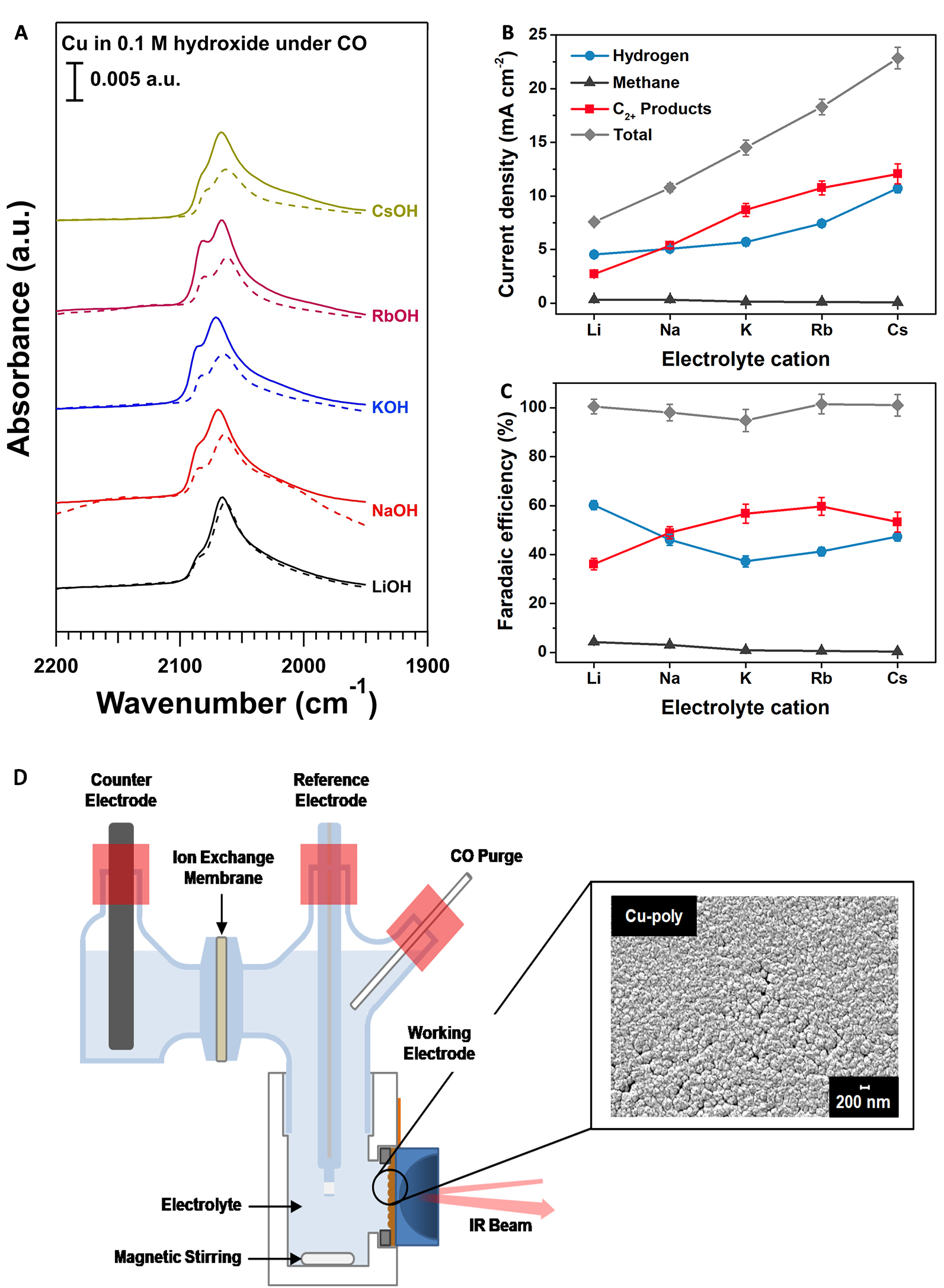
In this work, the researchers first tested the performance of carbon monoxide electrocatalytic reduction (CORR) in electrolytes containing different alkali cations. The data showed that the properties of the alkali cations have a significant effect on the activity and product distribution of CORR on the surface of polycrystalline Cu catalysts. Without considering the hydration layer of the cation, the rates of both CORR and hydrogen evolution reactions increase with the increase of cation size. The faradaic efficiency of CORR products also increases with the change of cation size from Li+ to K+, but remains essentially unchanged for larger cations. Combined with in situ infrared spectroscopy, the researchers found that different cations lead to different distributions of CO adsorption sites on Cu. As the cation size increases from Li+ to K+, the ratio of CO adsorbed on the step site to CO adsorbed on the terrace site gradually increases, and then stabilizes on larger cations. This trend is similar to the variation of the Stark tuning rate of CO adsorption measured in different cation hydroxide electrolytes. It can be seen that the interfacial electric field strength is the main reason for the increase in CORR reaction activity from Li+ to K+, and as K+ further changes to Cs+, the Stark tuning rate and CORR reaction rate both tend to stabilize, indicating that there are non-electric field components in the cation effect. This work combines electrochemical activity testing and in situ infrared spectroscopy. The researchers further emphasized that the cation effect is an important component of the overall influence of electrochemical interface composition and structure on electrode-mediated reactions, and revealed that the cation effect has both electric field and non-electric field components.
The study, titled "Understanding the Electric and Non-Electric Field Components of the Cation Effect on the Electrochemical CO Reduction Reaction", was published in the journal Science Advance on November 6, 2020. The co-corresponding authors of the paper are Associate Professor Lu Qi from the Department of Chemical Engineering at Tsinghua University and Associate Professor Xu Bingjun from the Department of Chemical Engineering and Biomolecular Engineering at the University of Delaware. This work was funded by the National Natural Science Foundation of China and other projects.