


Recently, Professor Zhang Rufan's research group at Tsinghua University developed a two-way regulation strategy. By simultaneously introducing the element gallium (Ga) and active site manganese (Mn) into ruthenium oxide (RuO2), Ga was used to optimize the valence structure of the dual active sites Ru and Mn at the atomic level, breaking through the constraints between the activity and stability of the dual sites, and significantly improving the oxygen reduction reaction (ORR) and oxygen evolution reaction (OER) performance and zinc-air battery performance.
The increasingly complex human activities and environmental problems urgently require the development of safe and effective energy storage and conversion technologies. Aqueous rechargeable zinc-air batteries (a-r-ZABs) have become a promising next-generation energy storage and conversion technology due to their high theoretical energy density (1086 Wh kg-1), high safety, low cost and abundant zinc reserves. The rational design and development of high-performance OER and ORR bifunctional catalysts are very important for the development and application of rechargeable zinc-air batteries. In recent years, the introduction of a metal site into a metal oxide to form a dual-active site bimetallic single-phase structure catalyst combining Mn-O and Ru-O (such as α-Mn1-xRuxO2, Ru(0.1)-MnO2, Mn-RuO2, and Mn0.3Ru0.7O2) can solve the limitation of a single site and meet the different needs of ORR and OER, which has attracted widespread attention. However, it is difficult to achieve the improvement of ORR and OER activity and stability by bidirectional regulation between the two sites, that is, generally only the valence structure and performance of the main metal oxide can be optimized, while the other active site introduced faces the choice of activity and stability. Therefore, developing a strategy to fully regulate the performance and break the activity-stability limitation is particularly important for the development of high-performance metal oxide bifunctional catalysts.
Based on the simple glucose-urea bubbling method (Figure 1), Zhang Rufan's research group developed a two-way regulation strategy. By introducing the element Ga and active site Mn into RuO2 at the same time, Ga was used to optimize the valence structure of the dual active sites Ru and Mn at the atomic level, breaking through the limitation between the activity and stability of the traditional dual sites. The authors combined experimental and theoretical analysis to confirm that the introduction of Ga caused the electron/charge redistribution on the dual active sites Mn and Ru, optimized the valence structure of Mn and Ru, and reduced the energy barriers of ORR and OER reactions by regulating the adsorption behavior of the reaction intermediates *O/*OH on the active sites. The Ga/MnRuO2 catalyst developed by the authors showed excellent bifunctional catalytic performance (Figure 2), with a potential difference (ΔE) of only 0.605 V, showing excellent catalytic activity, among which the ORR performance decayed to only 18 mV after 300,000 cycles of accelerated testing. The catalyst was compared with 100 recent bifunctional catalysts, and its comprehensive performance was better than most catalysts.
The a-r-ZABs based on Ga/MnRuO2 catalysts exhibit excellent performance in a wide temperature range (Figure 3). Among them, after more than 800 hours of cyclic charge and discharge tests at a current density of 10 mA cm-2 at room temperature, the catalyst still retains 86.7% of the initial specific capacity value. In addition, the catalyst has almost no attenuation after 2308 hours (about 13, 848 cycles) of cyclic charge and discharge tests at low temperature. This work proposes a two-way regulation strategy, which provides a new idea for the development of high-performance bifunctional ORR and OER catalysts and zinc-air batteries.
The above results were published in the international journal Angewandte Chemie International Edition under the title of "Breaking the Stability-Activity Trade-off of Oxygen Electrocatalyst by Gallium Bilateral-Regulation for High-Performance Zinc-Air Batteries". The first author of the paper is Li Yunrui, a postdoctoral fellow in the Department of Chemical Engineering, and the corresponding author is Associate Professor Zhang Rufan of the Department of Chemical Engineering. The above research work was supported by the National Natural Science Foundation of China and the National Key R&D Program.
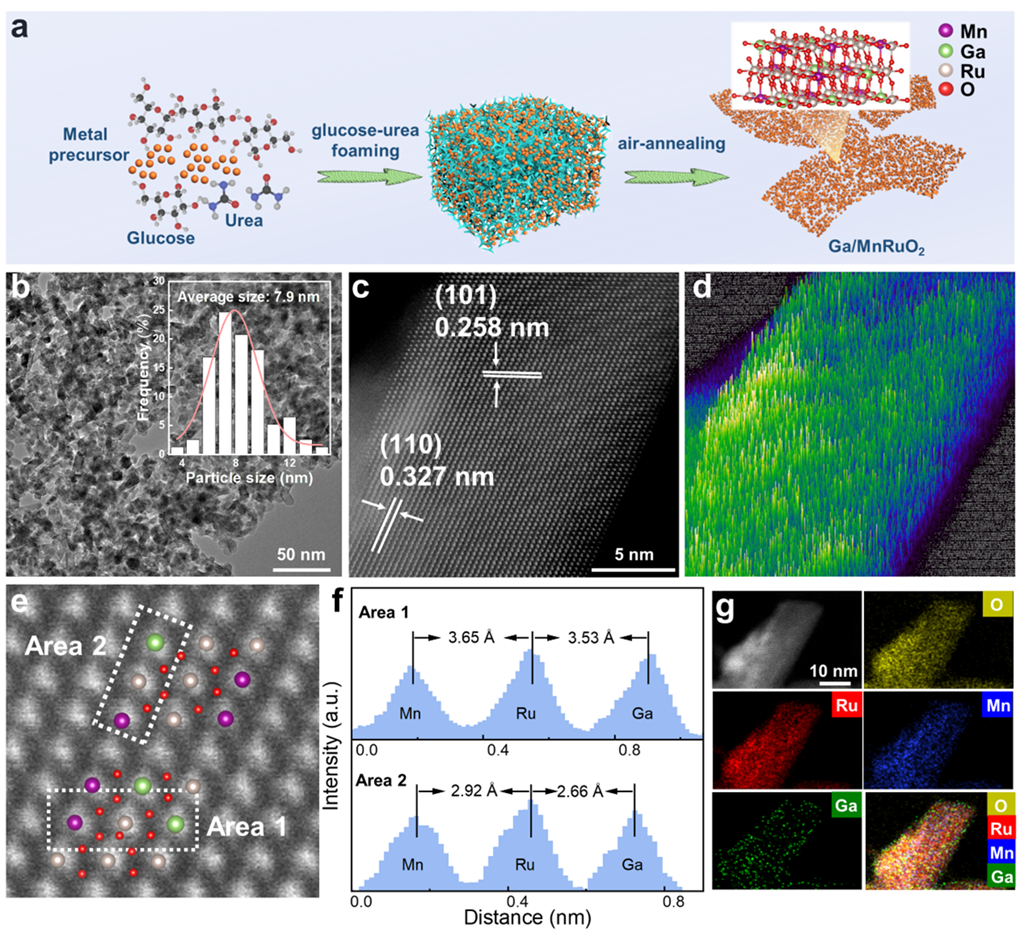
Figure 1. Synthesis and atomic structure characterization of the catalyst
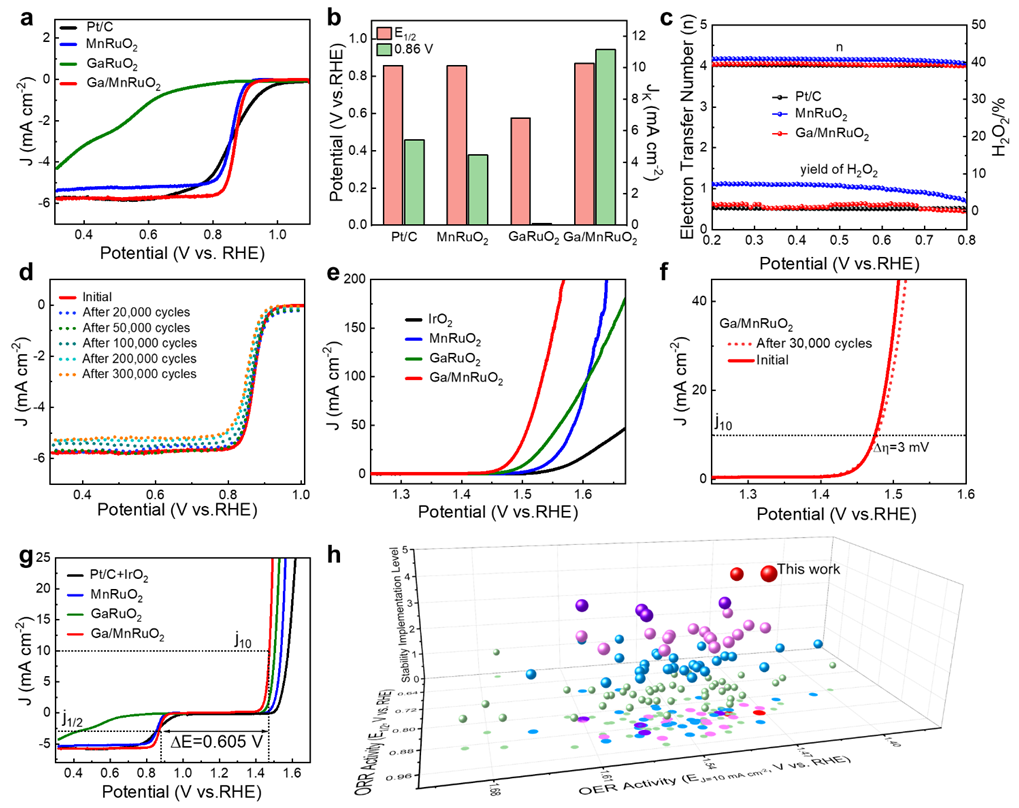
Figure 2. ORR and OER performance evaluation of the catalyst and comparison of its dual-functional comprehensive performance.
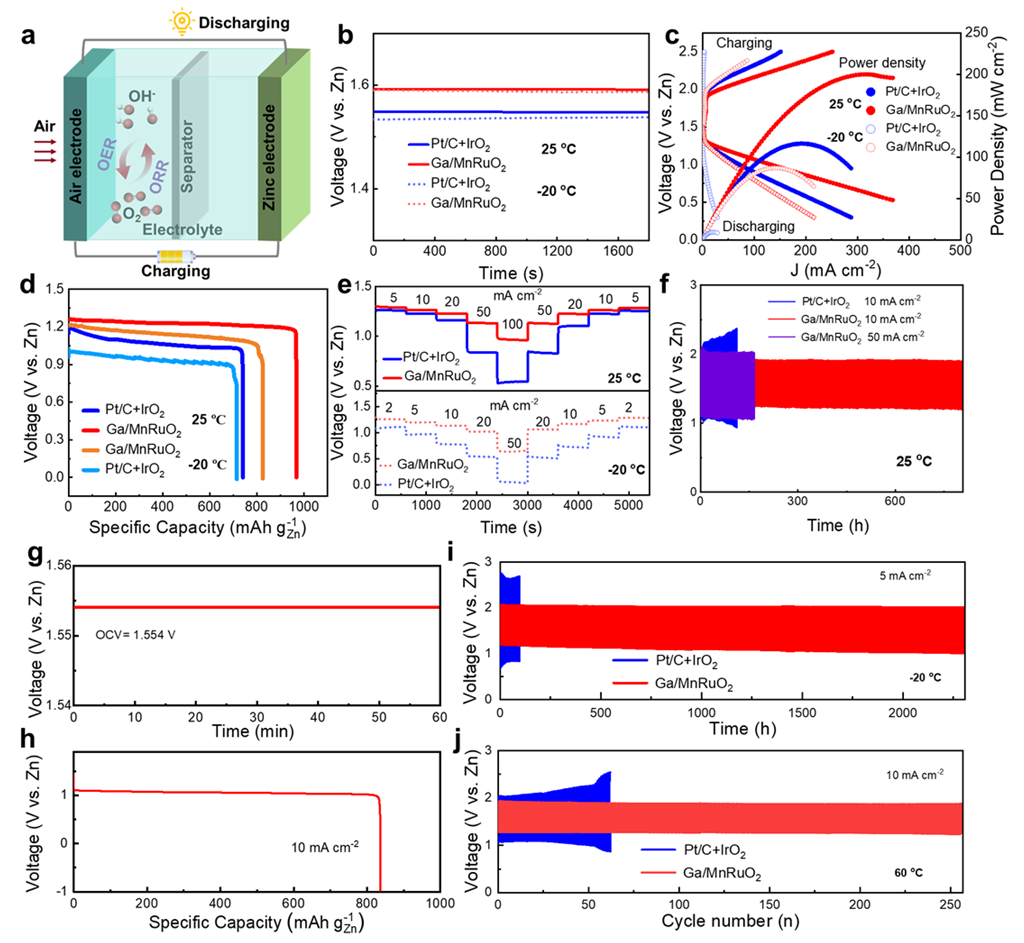
Figure 3. Performance evaluation of aqueous rechargeable zinc-air batteries